



Beyond Quick Relief: What Makes a Thoughtfully Formulated Ayurvedic Joint Pain Oil Different?

Joint discomfort, muscle stiffness and soreness can make everyday movement feel more difficult. For many people, massage is a familiar part of traditional wellness routines, and Ayurvedic oils have long been used as part of those routines.
But choosing an Ayurvedic joint pain oil should not be based only on how many herbs appear on the label or how quickly a product promises results.
A more useful question is: How thoughtfully has the oil been formulated?
This is where formulation, ingredient selection, proportioning and the intended mechanism of action become important.
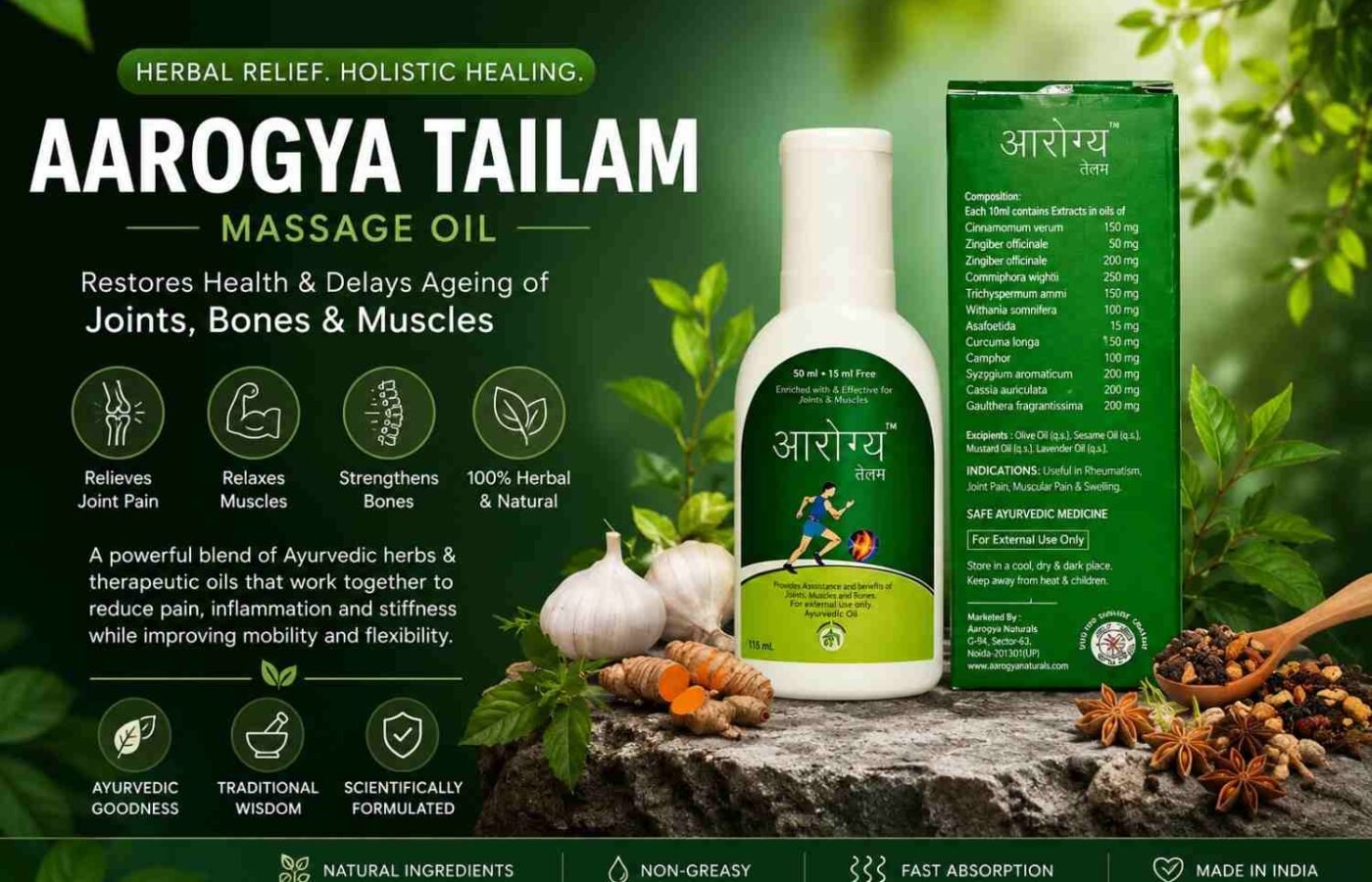
Aarogya Tailam from Aarogya Naturals takes this approach by combining herbal ingredients with traditional Ayurvedic understanding and modern scientific thinking. Aarogya Naturals describes it as a herbal massage oil formulated using original herbs according to recommended standards and procedures, with an emphasis on supporting the health of joints, muscles, bones and skin.
What Should You Look For in an Ayurvedic Joint Pain Oil?
The market for joint and muscle massage oils has expanded considerably. Products may be marketed as pain relief oils, Ayurvedic massage oils, herbal pain relief oils or muscle relaxant oils.
However, the word “herbal” alone does not tell you enough about a formulation.
A thoughtful product should consider:
- Which herbs and oils are included
- Why each ingredient is included
- How different constituents work together
- The proportion of potentially active ingredients
- The intended method of application
- Whether the formulation is designed for regular massage use
Aarogya Naturals’ information about Aarogya Tailam goes beyond simply listing herbs. The company explains the proposed mechanisms associated with several of its constituents, including phytoconstituents, alkaloids, rubefacients, phytonutrients and antioxidants.
That formulation-first approach is worth paying attention to when comparing an Ayurvedic joint pain oil with other products.
Aarogya Tailam: Combining Traditional Wisdom With Scientific Thinking
Aarogya Naturals describes Aarogya Tailam as a massage oil created by combining selected herbs with traditional and modern scientific wisdom. The product is positioned for joint, muscle, bone and skin wellness, particularly where stiffness and muscle soreness are concerns.
The company also explains that the oil is designed to be absorbed almost completely within seconds of massage, while retaining the natural fragrance of its constituents.
This is an important distinction.
A massage oil is not simply a collection of ingredients. The overall formulation determines how the ingredients are delivered and how the product fits into a massage routine.
Why Ingredient Proportion Matters
One of the more useful pieces of information published by Aarogya Naturals concerns Gandhpura oil, also known as oil of wintergreen.
According to Aarogya Naturals, Gandhpura oil contains methyl salicylate, and the company deliberately uses 2% V/V Gandhpura oil in Aarogya Tailam, which it states corresponds to approximately 1.8% methyl salicylate. The company explains that this proportion was selected as part of its focus on a rational and safe formulation for long-term use.
The significance is not simply the presence of Gandhpura oil.
It is the company’s emphasis on proportioning.
This is an area that is often missing from generic discussions about herbal massage oils. A longer ingredient list does not automatically mean a better formulation. Understanding what an ingredient contributes—and how much of it is appropriate within the overall formulation—is equally important.
How Does Aarogya Tailam Work?
Aarogya Naturals explains the formulation through several proposed mechanisms.
According to the company’s product information, phytoconstituents and alkaloids present in the herbs are intended to influence inflammatory mediators and support reduction of swelling and pain. The company also explains that rubefacients, combined with light massage, support blood circulation in the massaged area and help relax muscles.
The formulation also contains phytonutrients intended to nourish joints and support repair, while flavonoids and other antioxidants are described by Aarogya Naturals as helping restrict oxidative damage.
These mechanisms help explain why Aarogya Tailam is positioned as more than a conventional massage oil.
It is designed around a combination of botanical constituents and massage.
The Herbs Behind the Formulation
Aarogya Naturals has published detailed information about several constituents used in Aarogya Tailam.
Ginger
The company’s formulation article identifies gingerol from ginger as an important constituent. Aarogya Naturals describes gingerol in relation to oxidative stress, inflammation and cartilage cells.
Turmeric
Curcumin from turmeric is another constituent discussed by Aarogya Naturals. The company describes curcumin in relation to anti-inflammatory, antioxidant and anti-arthritic activity.
Boswellia
Boswellia serrata, commonly known as Shallaki, is discussed for its boswellic acids. Aarogya Naturals explains that boswellic acids are associated with inhibition of the 5-lipoxygenase enzyme involved in inflammatory mediator pathways.
Cinnamon
Aarogya Naturals identifies cinnamaldehyde from cinnamon as a constituent associated with antioxidant and anti-inflammatory mechanisms. The company’s formulation information also discusses its relationship with inflammatory signalling and joint health.
Ashwagandha
Ashwagandha is included in the formulation discussion because of its relationship with collagenase activity and the company’s stated interest in supporting cartilage health.
Fenugreek
Fenugreek is described by Aarogya Naturals as a source of nutrients including fatty acids and various vitamins, minerals and amino acids. The company connects these nutritional components with its broader approach to supporting joints, muscles, bones and skin.
Black Pepper
Piperine from black pepper is another constituent highlighted by Aarogya Naturals. The company’s formulation information associates piperine with flavonoids, antioxidants and its role alongside other ingredients in the massage formulation.
These ingredients demonstrate why evaluating an Ayurvedic joint pain oil should involve more than counting the number of herbs. The question is how the ingredients have been selected and combined.
A Formulation Designed for More Than One Type of Massage Need
Aarogya Tailam is positioned by Aarogya Naturals for several situations involving muscles and joints.
The company’s published material discusses its use in relation to:
- Joint discomfort
- Muscle stiffness and soreness
- Postural discomfort
- Post-traumatic discomfort
- Osteoarthritis-related concerns
- Sprains and strains
- General muscle and joint massage routines
The company’s own article describes the formulation as being intended for joint and muscle disorders and discusses its role in a broader approach to muscle, bone and joint wellness.
This makes Aarogya Tailam relevant for people searching for terms such as joint pain oil, Ayurvedic muscle relaxant oil, herbal pain relief oil, or massage oil for arthritis.
Importantly, these terms should describe what people are looking for—not become a reason to make exaggerated promises about what any product can guarantee.
The Role of Massage
The oil itself is only one part of the experience.
Aarogya Naturals specifically explains the role of light massage in conjunction with the formulation. According to the company’s product information, massage with the oil works alongside its rubefacient constituents to support blood circulation in the massaged area and relaxation of muscles.
That makes the application ritual an important part of using an Ayurvedic massage oil.
Rather than treating massage as an afterthought, Aarogya Tailam is designed around it.
What Makes Aarogya Tailam Different From a Generic Pain Oil?
The biggest difference is not necessarily the number of ingredients.
It is the formulation philosophy.
Aarogya Naturals emphasizes:
- Herbal formulation
Aarogya Tailam is described by the company as 100% organic and herbal.
- Traditional + scientific approach
The product is described as combining traditional Ayurvedic wisdom with modern scientific understanding.
- Ingredient-specific reasoning
Aarogya Naturals explains the proposed roles of individual constituents rather than presenting an unexplained list of herbs.
- Attention to proportion
The company’s discussion of Gandhpura oil provides a specific example of its focus on ingredient concentration and formulation balance.
- Natural fragrance
The company states that the natural fragrance of the constituents has not been masked.
- Absorption
Aarogya Naturals states that the oil gets almost completely absorbed within seconds of massage.
Together, these characteristics provide a stronger story than simply calling a product “natural.”
What Do Customers Say About Aarogya Tailam?
Customer experience is different from scientific or clinical evidence, so it should be treated accordingly.
Aarogya Naturals’ product page currently displays a 4.9 out of 5 rating based on 114 reviews, with 106 five-star reviews and 8 four-star reviews shown on the page.
One customer, Parul Jain, described using Aarogya Tailam for her mother’s knee discomfort and highlighted the importance of consistency rather than expecting overnight results.
Another reviewer, Dr. Krishan Gopal, identified himself as a senior pharmacist and naturopathist and wrote positively about the product’s composition and intended use.
These reviews provide insight into customer experiences, but they should not be interpreted as controlled clinical evidence.
That distinction is important when evaluating any herbal or Ayurvedic product.
How to Choose a Herbal Pain Relief Oil Responsibly
When comparing products, it is tempting to choose whichever product promises the fastest or strongest result.
A better approach is to look at the formulation.
Ask:
Are the ingredients clearly explained?
A product should ideally give consumers more than a collection of attractive herb names.
Is there a reason behind the formulation?
Understanding why particular herbs and oils have been included can provide greater confidence than simply seeing a long ingredient list.
Does the manufacturer discuss proportions?
Ingredient concentration can matter, particularly when a formulation contains active constituents.
Are the claims presented responsibly?
A trustworthy wellness brand should distinguish customer experiences, traditional use and product information from clinical evidence.
Is the product designed around an actual use routine?
For a massage oil, application and massage are central to the experience.
Aarogya Tailam as Part of a Consistent Wellness Routine
One of the clearest lessons from Aarogya Naturals’ own customer feedback is that consistency matters.
A customer review published on the product page specifically says that Aarogya Tailam was used consistently and that the experience was not presented as an overnight solution.
That is a useful perspective in a market where many products compete on promises of immediate results.
An Ayurvedic massage routine can instead be approached as a regular self-care practice.
For people looking for an Ayurvedic joint pain oil, knee pain oil, muscle pain massage oil, or herbal pain relief oil, the better question may not be “How quickly will this fix my problem?”
It may be:
Does the formulation make sense, are the ingredients thoughtfully selected, and can the product fit consistently into my wellness routine?
The Bigger Picture: Nature Meets Formulation Science
The strongest opportunity for Ayurvedic wellness products is not to compete with conventional products by making increasingly aggressive claims.
It is to communicate clearly.
Aarogya Tailam provides an example of that approach. Aarogya Naturals combines herbal ingredients with an explanation of their proposed mechanisms, discusses ingredient proportions, and positions the product around massage and joint and muscle wellness.
That combination of traditional knowledge, botanical ingredients and formulation-focused thinking gives consumers something more useful than marketing slogans: a reason to understand what they are using.
For anyone researching an Ayurvedic massage oil, massage oil for arthritis, Ayurvedic muscle relaxant oil, or joint pain relief oil, formulation transparency is worth putting ahead of exaggerated promises.
Final Thoughts
A good herbal massage oil is not defined simply by the number of herbs inside the bottle.
It is defined by how thoughtfully those ingredients have been selected, combined and explained.
Aarogya Tailam is built around that philosophy. From its herbal composition and ingredient-specific mechanisms to its attention to formulation proportions and massage-based application, Aarogya Naturals presents the product as a meeting point between traditional Ayurvedic knowledge and modern scientific understanding.
For consumers exploring natural approaches to joint and muscle massage, that kind of transparency can be a more meaningful starting point than a promise of instant results.
Learn more about Aarogya Tailam:
https://www.aarogyanaturals.com/product-page/aarogya-tailam