


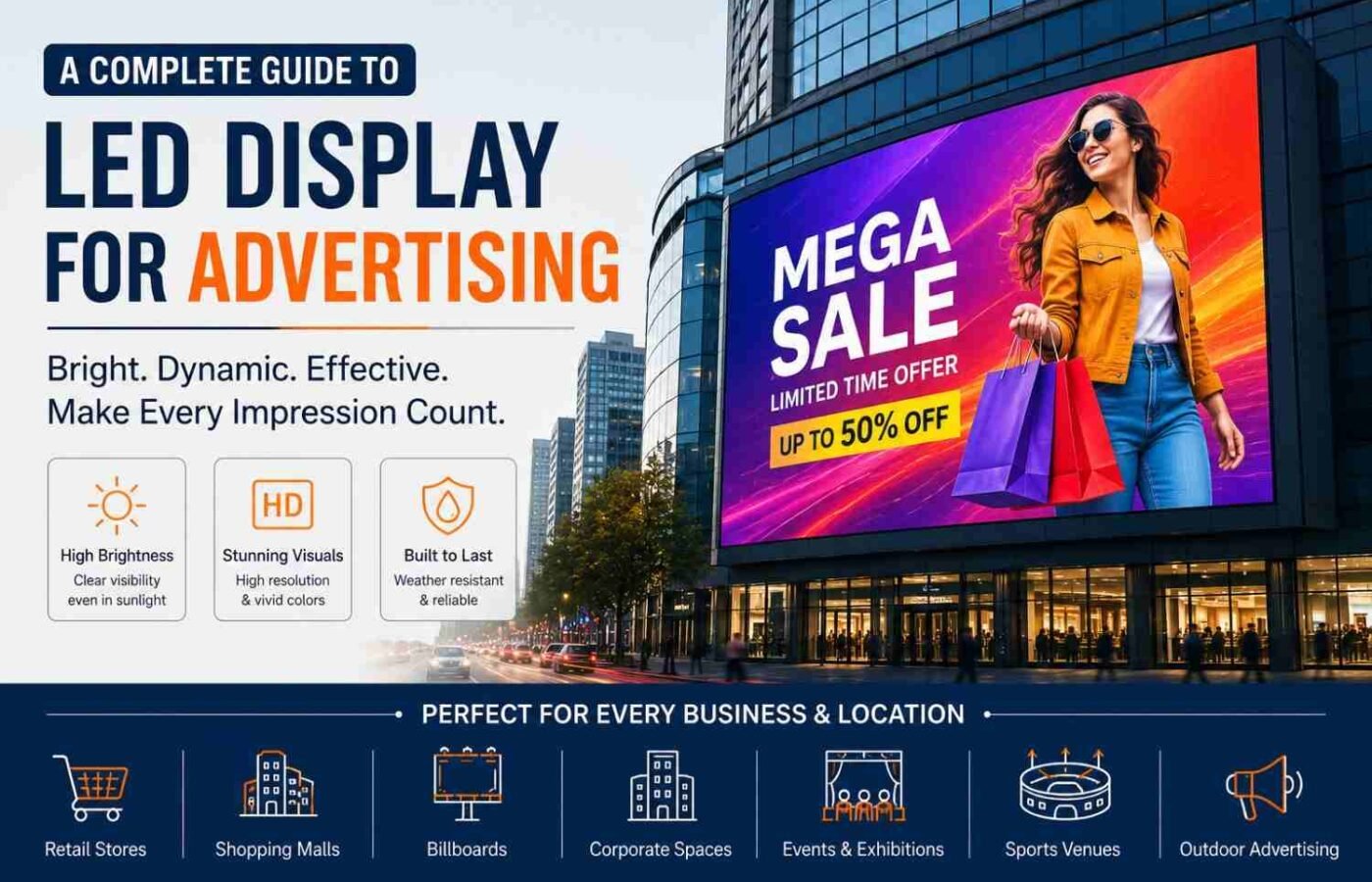
LED Display for Advertising: A Practical Guide for Businesses

Advertising is becoming increasingly visual. Businesses want their promotions, products and brand messages to stand out in places where customers are surrounded by competing information.
This is one reason an LED display for advertising has become an important option for businesses, retailers, outdoor advertisers, event organisers and other commercial organisations.
Unlike conventional printed signage, an LED advertising display can show videos, images, text and changing promotional messages on the same screen. However, choosing the right display requires more than simply selecting the largest screen or the highest brightness.
The installation environment, viewing distance, pixel pitch, brightness and weather protection all need to be considered.
What Is an LED Display for Advertising?
An LED display for advertising is a digital display made from light-emitting diodes that produces images, text, graphics, and video content.
These displays can be used in both indoor and outdoor environments.
Indoor applications can include:
- Retail stores
- Shopping malls
- Showrooms
- Corporate offices
- Hotels
- Restaurants
- Exhibition spaces
- Conference venues
Outdoor applications can include:
- Roadside advertising
- Building façades
- Petrol stations
- Sports venues
- Transit locations
- Outdoor events
- Commercial properties
The major difference from static signage is content flexibility. Instead of replacing printed material every time a campaign changes, businesses can update the content displayed on the LED screen.
Why Businesses Use LED Advertising Displays
An LED advertising screen can serve multiple purposes from a single installation.
Dynamic advertising
Businesses can display videos, animations, product images, and promotional messages instead of relying only on static graphics.
Multiple campaigns on one screen
A single display can be used for different advertisements or messages throughout the day.
High visibility
LED displays can be designed with brightness levels appropriate to their environment. This is particularly important for outdoor screens exposed to daylight.
Flexible installation
LED displays are modular, which allows manufacturers to configure screens according to the available space and required dimensions.
Long-term digital signage
Instead of treating advertising as a one-time printed installation, businesses can use an LED screen as a reusable digital communication platform.
Indoor vs Outdoor LED Advertising Screens
The first question to answer when selecting an LED display is simple:
Where will the screen be installed?
An indoor display and an outdoor display have different technical requirements.
Indoor LED Advertising Displays
Indoor screens are generally installed in controlled environments where there is no direct exposure to rain and outdoor weather.
Because audiences can be relatively close to an indoor screen, finer pixel pitches are often appropriate.
For example, Sunshine Display System lists P2.5, P3, and P4 configurations for indoor LED advertising applications.
Its published specifications show:
- P2.5: recommended viewing distance of 3–6 metres
- P3: recommended viewing distance of 4–8 metres
- P4: recommended viewing distance of 6–12 metres
This illustrates why viewing distance should be considered before selecting pixel pitch.
Outdoor LED Advertising Displays
Outdoor screens have to operate in a much more demanding environment.
They may encounter:
- Direct sunlight
- Rain
- Dust
- Temperature changes
- Humidity
- Wind
For this reason, outdoor LED advertising displays require appropriate brightness and environmental protection.
Sunshine Display System’s published outdoor configurations include P5, P6, P8, and P10, with IP65 protection and brightness specifications ranging from 5,500 to 8,000 nits depending on the model.
For outdoor advertising, the display specification should also be considered together with the supporting structure and installation conditions.
Understanding Pixel Pitch
Pixel pitch is one of the most important terms to understand before purchasing an LED advertising display.
It refers to the distance between individual pixels on an LED module and is measured in millimetres.
For example:
- P2.5 means a 2.5 mm pixel pitch
- P4 means a 4 mm pixel pitch
- P6 means a 6 mm pixel pitch
- P10 means a 10 mm pixel pitch
A smaller pixel pitch means pixels are positioned more closely together, resulting in greater pixel density.
But smaller is not automatically better for every installation.
Imagine two advertising screens.
One is installed inside a showroom where customers stand only a few metres away. Another is installed beside a road where viewers are much farther away.
The two locations do not necessarily require the same pixel pitch.
The practical rule
Start with viewing distance, then select the pixel pitch.
This approach can prevent businesses from paying for a specification that does not provide a meaningful benefit for their particular installation.
Why Brightness Matters
Brightness is especially important for outdoor LED advertising.
A display that looks excellent indoors may not provide the same visual performance when exposed to strong daylight.
Sunshine Display System’s published specifications illustrate this difference:
| Application | Example Configurations | Published Brightness |
| Indoor | P2.5–P4 | 800–1,800 nits |
| Outdoor | P5–P10 | 5,500–8,000 nits |
The exact brightness requirement depends on the installation environment.
The objective should not simply be to purchase the brightest display available. The display should have an appropriate brightness level for its surroundings and intended use.
Outdoor Advertising Requires Weather Protection
An outdoor LED display needs protection against environmental conditions.
One specification buyers should pay attention to is the IP rating.
Sunshine Display System lists IP65 protection for its standard outdoor P5–P10 advertising screen configurations.
However, the screen itself is only part of an outdoor installation.
The complete project can also involve:
- Mounting structure
- Electrical protection
- Cable management
- Drainage considerations
- Maintenance access
- Wind-load considerations
- Site-specific engineering
This is why purchasing an outdoor LED display should involve more than comparing screen prices.
How to Choose an LED Display for Advertising
Before requesting quotations, businesses should define several basic requirements.
1. Identify the installation environment
Is the screen going inside a showroom or outside on a building?
This immediately narrows the appropriate product category.
2. Measure the viewing distance
Determine approximately how close the audience will be to the screen.
This is one of the most useful inputs for choosing pixel pitch.
3. Determine the available screen area
Measure the wall, façade, billboard structure or other installation area.
The screen should fit the location while maintaining suitable proportions for the intended content.
4. Consider ambient light
Outdoor locations and brightly illuminated indoor spaces may require different brightness levels.
5. Check environmental requirements
For outdoor installations, ask about IP protection, operating temperature, wind conditions and maintenance access.
6. Consider content requirements
If the display will regularly show video or content that is photographed on camera, refresh rate should be included in the technical comparison.
7. Ask about maintenance
Find out how LED modules, power supplies, and other components can be accessed when servicing is required.
Front-access designs can be particularly useful where rear access is restricted, depending on the installation.
Common Applications of LED Advertising Displays
The versatility of LED technology means that the same basic display concept can be adapted to many environments.
Retail and Showrooms
Retail businesses can use LED screens for product promotions, seasonal campaigns, branding, and visual merchandising.
Shopping Malls
Large displays can be installed in high-visibility areas to communicate promotions and advertising content.
Outdoor Billboards
Large-format LED screens can provide dynamic advertising opportunities along roads and commercial locations.
Building Façades
LED displays can be integrated into commercial buildings to create prominent digital advertising surfaces.
Sports Venues
LED screens can support advertising, sponsorship messages, and event-related visual content.
Events and Exhibitions
Portable or modular LED systems can be used for stage backgrounds, sponsor branding and promotional displays.
Mobile Advertising
LED screens can also be installed on customised vans and trucks, allowing advertising campaigns to move between locations.
Questions to Ask an LED Display Manufacturer
Before selecting a supplier, don’t compare quotations based only on the total price.
Ask the manufacturer to provide the technical specifications for the proposed screen.
Important questions include:
Q. What pixel pitch is suitable for the viewing distance?
Q. What brightness is specified?
Q. Is the proposed model designed for indoor or outdoor use?
Q. What is the IP rating for outdoor applications?
Q. What refresh rate does the display provide?
Q. What screen dimensions are being proposed?
Q. How will the display be mounted?
Q. How will maintenance be performed?
Q. What warranty is provided?
Q. Does the supplier provide installation and after-sales support?
These questions make it easier to compare different quotations on a like-for-like basis.
Why Site Assessment Matters
Two businesses may request an LED advertising screen of the same approximate size but require completely different specifications.
For example, a screen inside a shopping mall may have a short viewing distance and controlled lighting.
A roadside advertising screen may have a much greater viewing distance, direct sunlight, and exposure to rain and wind.
Simply copying the specification from one project to another can therefore result in an unsuitable solution.
A site assessment allows the manufacturer or system integrator to evaluate the actual installation conditions before recommending the screen configuration.
LED Advertising Is More Than a Screen
A successful LED advertising project is not only about the LED modules.
The final system can involve:
- LED modules
- Cabinets
- Receiving cards
- Sending/control systems
- Power supplies
- Structural support
- Electrical systems
- Content management
- Installation
- Maintenance
For larger outdoor installations, the supporting structure and site conditions can be just as important as the display specification.
Businesses should therefore evaluate the supplier’s ability to handle the complete project rather than looking only at the LED panel price.
Final Thoughts
An LED display for advertising can give businesses a flexible way to communicate promotional and brand content through digital visuals.
But there is no universal specification that works for every location.
The right choice depends on the installation environment, viewing distance, pixel pitch, brightness, screen dimensions, weather protection, and maintenance requirements.
Before purchasing, define the location and viewing conditions first. Then ask an experienced LED display manufacturer to recommend a specification based on those requirements.
For businesses looking for a customised LED advertising solution, Sunshine Display System manufactures indoor and outdoor LED advertising screens in different pixel pitches and configurations, with project-specific sizing and installation support.
A properly specified display can be a much more practical investment than simply choosing the cheapest or highest-specification screen available.